
· Holt Ferris
DIY Fly Tying Vise: What Works, What Slips
Search the phrase and you get clothespins glued to blocks of wood, locking forceps wedged into a workbench, and a lot of confident advice from people who tied three flies that way and then stopped. I have tried most of them — on a kitchen table, and once in the back of a truck the morning a vise stayed home. Some of it holds a hook. Some of it holds a hook for about ninety seconds. What follows is what each rig does mechanically, which hook size exposes it, and the one function no improvised holder performs at all.
What a vise has to do while you tie
Before judging any rig, it helps to be precise about the job, because most people underestimate it. A tying vise is not a thing that stops a hook falling off the table. It has three tasks running at once.
The first is resisting torque. You build a fly by pulling thread in circles around a hook shank, at a tension you feel in your fingertips, hundreds of times. Every wrap is a small twist applied around the axis of the hook. Gravity is trivial next to that; the load is rotational, and it arrives in the same direction over and over until anything with a soft grip has walked around a few degrees without you noticing.
The second is holding a repeatable position. The hook has to sit where you last saw it, at the same angle, for the whole fly. A shank that creeps down two millimetres between the tail and the head is what produces a body that tapers the wrong way and a head you cannot get neat.
The third is clearance. Your bobbin hand needs to pass under the shank without hitting anything. Anything that grips a hook by surrounding it — a pair of pliers laid flat, a lump of putty — has already failed that one, whatever else it does.
The clothespin rig, and the moment it gives up
This is the classic. A wooden spring clothespin, sometimes glued upright into a block or clamped in a second holder, jaws padded with a strip of leather or a couple of turns of tape.
It works better than it has any right to on big wire. A #4 or #6 streamer hook has a shank thick enough that the clothespin's flat wooden faces actually contact a length of it, and the spring pressure spreads across that contact. Lay a thread base on a big Woolly Bugger hook in one and it will hold.
The failure is structural, and it is the same one every time: you cannot set the pressure. A clothespin closes with whatever force its spring provides, and that force was chosen by whoever made the spring, for laundry. On a real head the clamping force is a setting — the cam drives the jaws and a threaded collar decides how far they close, which is the whole subject of our guide to the lever on a fly tying vise. Strip the setting out of the mechanism and you get one grip strength for every hook you will ever tie.
The padding makes it worse in a specific way. Leather and tape are compliant, which is why they grip at all, and compliance is exactly what lets a hook rotate under sustained thread tension. The wire sinks into the padding, the padding relaxes over the next few minutes, and the shank quietly turns. You find out at the whip finish, when the fly you have been building is thirty degrees off from where you set it.
Locking forceps: a real bite, nothing to hold it
Locking forceps — the ratcheting kind already sitting in most vests for pinching barbs — are the best of the improvised holders, and it is easy to see why. The ratchet gives you discrete settings, so unlike the clothespin you can choose a tighter or looser bite. The serrated tips bite steel rather than squashing around it. On a #10 nymph hook a pair of forceps holds the wire genuinely well.
What forceps do not have is a base. The whole point of a vise is that the hook is anchored to something that outweighs your hands, and forceps anchor the hook to a pair of handles that then have to be anchored to something else. So the rig becomes forceps clamped inside a second thing, and every joint you add is another place the assembly can move.
There is a second problem people run into fast: the serrations that grip so well are aggressive, and on fine wire they mark it. A scored hook is a hook with a stress riser in it, and stress risers are where wire opens up under a fish.
Hook sizes the jaw closes on without an adapter
— Tailwater product specifications, 2026
The bench vise and a scrap of hardwood
The heaviest option, and the one that solves the anchoring problem outright. A woodworking or engineer's vise bolted to a bench is not going anywhere. Cut a slot in a hardwood offcut, drop the hook bend into the slot, close the vise on the block, and you have a hook held by something immovable.
The mass is real, and it is the only DIY approach that genuinely defeats torque. What it costs you is everything else. A bench vise sits where it is bolted, at bench height, jaws facing whichever way the bench faces. Tying happens at eye level with your forearms supported — the working height, chair and lighting question our fly tying desk guide walks through in detail. A hook held eight inches too low, in a jaw the size of your fist, puts your hands in a position you will feel in your neck after a dozen flies.
The jaws are the other half of it. Bench vise jaws are flat plates measured in inches, built to grip timber. They meet a hook at two points and grip nothing, unless you interpose the wooden block, at which point the block is doing the holding and it is only as good as the slot you cut. Every hook size wants a different slot.
Why a #14 dry hook is where every rig gets found out
If you test improvised holders you will notice they all fail in the same neighbourhood, and it is not the smallest hooks. It is the middle of the range.
Above a #14, wire is thick enough that any grip has something substantial to close on. Errors in pressure and alignment get absorbed. Below a #14, the wire is so fine that most people abandon the improvised rig immediately, because it visibly does not work and no argument is needed.
A #14 is the trap, because it very nearly works. The hook sits there, feels solid to a finger test, and stays put through the tail and the body. Then you reach the hackle, where thread tension climbs and every wrap pulls in the same rotational direction, and the hook turns a few degrees. Then a few more. The fly is not ruined; it is subtly wrong, and you spend the evening blaming your hands. A #14 also happens to be the hook a huge share of trout dries and nymphs are tied on, so this is not an edge case — it is the middle of the box.
Purpose-built jaws deal with the middle of the range by closing a narrow slot along a length of the hook bend rather than pinching at a point, and by letting you set how hard that slot closes for the wire in front of you.
Jaw opening on the Tailwater vise
— Tailwater product specifications, 2026
Rotation is the part you cannot improvise
Everything above is a question of degree — a DIY rig grips less well, less repeatably, at fewer sizes. Rotation is different in kind, because it is not a stronger version of something an improvised holder does badly. It is a thing that does not exist in the rig at all.
True rotary tying means the head spins on bearings, with the hook shank sitting on the axis of that spin, so the fly turns in place instead of orbiting. That is what lets you wind hackle by turning the head while your hands hold the feather still, and what lets you flip the fly over to check the underside without unclamping it. Our guide to using a rotary vise covers the technique, and rotary vs. fixed covers when each style is the right call.
You can make something spin on a bench. What you cannot do on a bench is put the hook on the axis of the spin and keep it there, because that requires a jaw whose centreline is machined concentric with the bearing it rides in. Get it wrong by a millimetre and the fly sweeps a circle every time you turn the head, which moves it out from under your bobbin — the opposite of what rotation is for. This is the one function where the gap between an improvised holder and a made one is total rather than partial.
What a homemade rig is actually good for
Two things, and they are real.
It teaches you what the hook does under load. Spend an hour watching a clothespin let a shank creep and you understand torque on a fly in a way no article conveys, including this one. When you later set clamping force on a proper collar, you will know precisely what you are setting it against.
And it gets a fly tied when the alternative is no fly tied. A streamer hook in forceps in a hotel room the night before a trip is a legitimate rig for one fly on big wire. Nobody should feel bad about that. Just know which hook sizes it covers before you commit an evening to it.
Where it stops working is repetition. The whole reason a bench setup exists is to tie the same fly six times and have all six come out alike, and that is a question of a mechanism you can set and return to, not a grip you re-judge on every hook.
Where the Tailwater vise picks it up
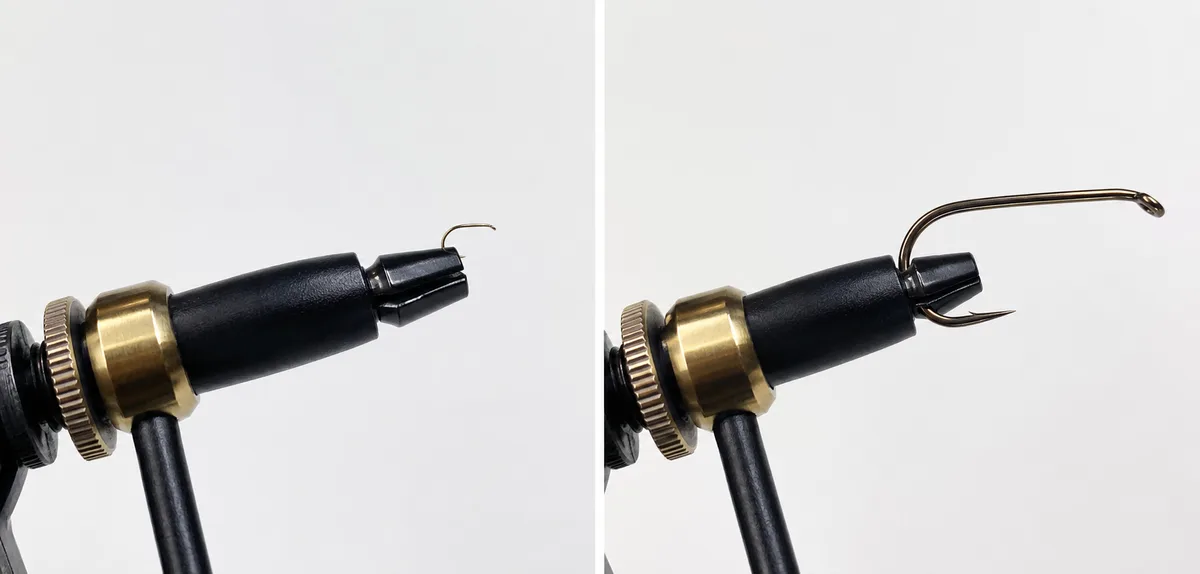
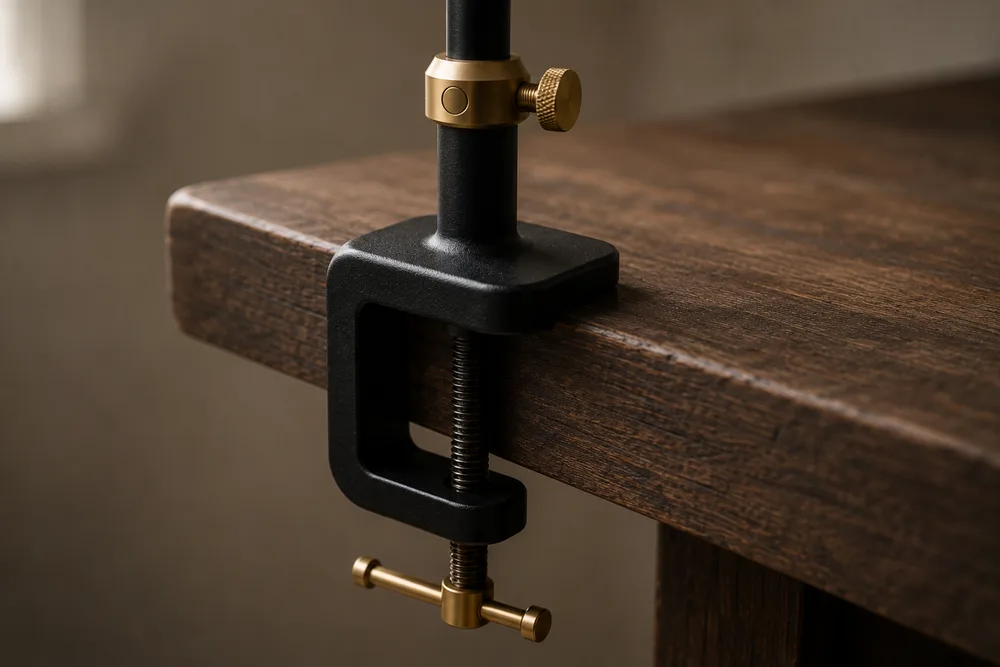
Our rotary fly tying vise is the made version of everything the DIY rigs approximate. The head is cam operated with a knurled collar, so clamping force is a setting you choose for a wire diameter and return to, not a spring's opinion. The hardened-steel jaw closes on hooks from #4 down to #24 with no adapter to swap. The head rides on brass bushings and turns a full 360 degrees with the hook on the axis, so hackle winds itself while your hands stay still. And it locks to any desk edge on a C-clamp base with two brass thumb screws, which puts the hook at your working height rather than at bench height.
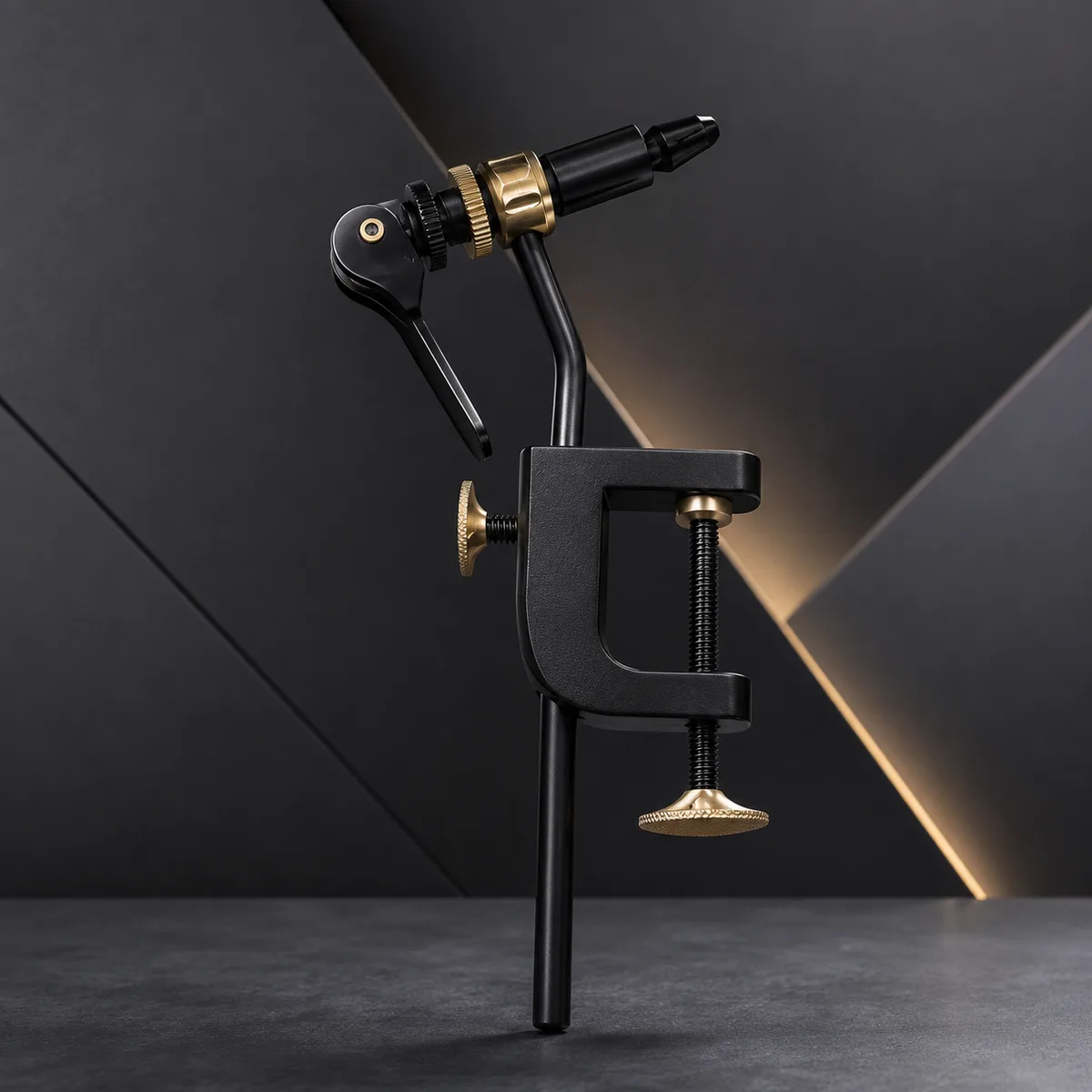
It is $49.95 on its own, or $79.95 inside the Complete Fly Tying Kit with the bobbin holder, whip finisher, hackle pliers, tweezers and thread a first bench needs. Never clamped a hook at all? Start with how to tie your first fly. Weighing all three setups side by side? That is what our best fly tying vise page is for.
Average rating across 47 verified buyers
— Tailwater buyer ratings, 2026
DIY fly tying vise FAQ
Can a clothespin really hold a hook for tying?
A wooden clothespin closes on a hook with spring pressure only, and that pressure is fixed by the spring rather than set by you. It will pin a heavy streamer hook while you lay a thread base, and it starts letting the hook rotate as soon as you pull tension around the shank, because nothing in the rig resists twist along the hook axis.
What hook size does an improvised holder stop working at?
Somewhere around a #14 for most rigs. Above that, the wire is thick enough that even a soft grip has something to bite. Below it, the wire diameter drops faster than the improvised jaws can compensate, the hook sinks into whatever padding is holding it, and the point ends up somewhere you cannot see while you tie.
Can you add rotation to a homemade fly tying vise?
Rotation on a tying vise is not a hinge, it is a head that spins on bearings with the hook sitting on the axis of that spin. Improvising the spin is possible. Improvising it so the hook stays on the axis while it turns is the part that does not happen on a bench, and off-axis rotation moves the fly out from under your bobbin instead of turning it in place.

Holt Ferris · Fly Tyer and Guide, 15 Seasons on the Water
Fly fishing guide and tyer for 15 seasons. Writes the Tailwater guides, from a first Woolly Bugger to true rotary technique.